
Throughout life, we constantly make decisions, both conscious and unconscious- from what to eat and read to whom we are associating with. But at the core of our lives, are a handful of profoundly consequential choices: the career we pursue, the jobs we accept, and the partner we commit to and in the end a quest for happiness. In responsible roles, the stakes multiply. Our choices impact not just us, but our family and social sphere.
The greater the responsibility, the heavier the consequences of our actions. The Bhagavad Gita starts with an equally critical choice: a war with a death toll in the millions and consequences spanning several generations. At first, Arjuna was filled with agony (paśyāmi viparītāni,Bg.1.30) and reduced to paralysis (yad vā jayema yadi vā no jayeyuḥ,Bg.2.06). Till he turned to Lord Krishna in despair, seeking to know dharma, the right thing to do (śiṣyas te ’haṁ śādhi māṁ tvāṁ prapannam,Bg.2.07), which gradually led him to understand, as he surrendered unto the Lord, that the fight was for the protection and establishment of the dharma or righteousness under the direction of the Supreme and not for the shake of causing violence.
Life’s disruptions trigger responses based on both the external events and our current internal state. Since moods often fluctuate randomly, their inherent unpredictability is what frequently aggravates our sense of perplexity and perception.
Gita’s wisdom clarifies that our moods are influenced by the three modes of material nature that shape our worldly experience. These modes are in perpetual conflict within our consciousness, with each one trying to overpower the others (Bg. 14.10)
Table of Contents
Typical mood influenced by each of the three modes(gunas)
Let’s look at the typical mood influenced by each of the three modes(gunas):
Introspection
Instrospection is stimulated by the mode of Goodness (Sattva). It enables us to think carefully to determine the best course of action and then act calmly to implement it. For this process to work soundly and provide true clarity, but still it needs to be guided by scriptural instructions.
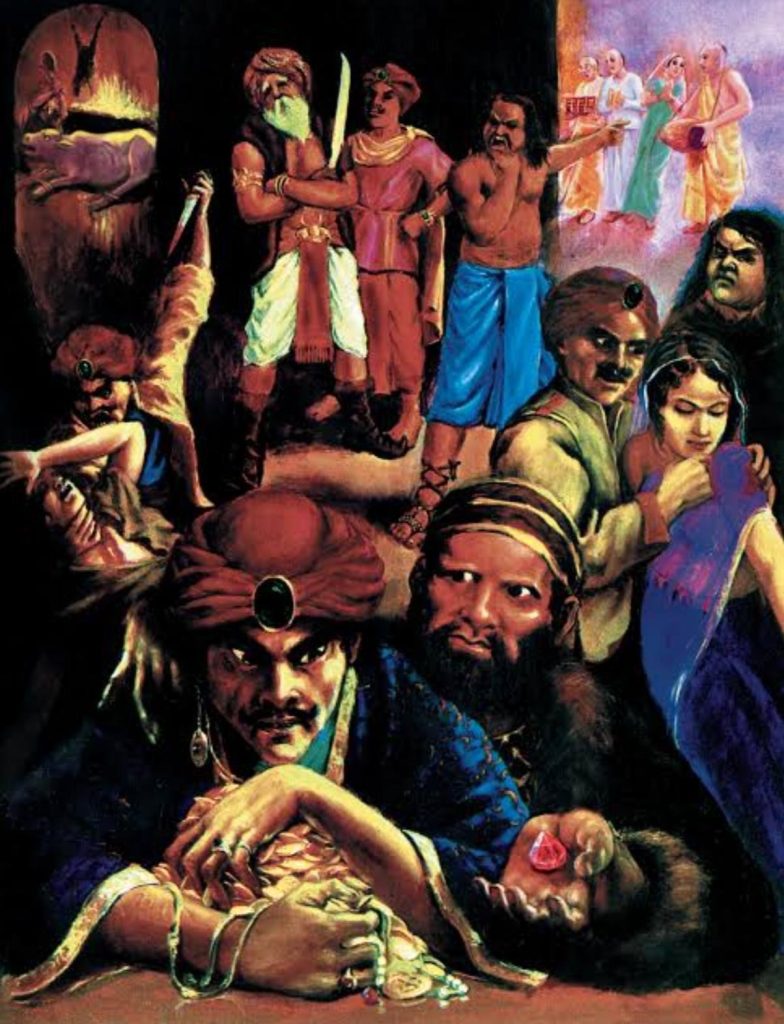
Indiscretion
Indiscretion is triggered by the mode of passion (Rajas). It provokes us towards acting without thinking, and this impulsive behaviour usually aggravates the initial perplexity, leading to further complication and regret. Even if someone is aware of what is right and wrong, still one is driven by one’s uncontrollable desires.
Indecision
Indecision is a characteristic of the mode of ignorance (Tamas). It prevents us from both thinking clearly and acting decisively, often degenerating into self-pity and violence. It lacks proper knowledge and the power of discrimination is diminished, one isn’t aware what should actually be done and not done.
Life is a continuous series of decisions- a mix of small and large, wise and unwise, some mistakes we know about, and some we don’t, but however it doesn’t give us a reason to do ill and we should cultivate some higher knowledge from the most authentic sources like Srīmad Bhagavad-Gītā and Srīmad Bhāgavatam.
The Bhagavad-Gītā highlights two contrasting ways we approach decisions
Intelligence in Goodness(Sattva) (Bg.18.30) This intelligence is clear and discerning. It allows us to thoughtfully consider all the necessary factors to choose a wise, balanced course of action. It knows what is truly right and wrong and is guided by the right knowledge. In Bg. 18.30, the Lord instructs;
pravṛttiṁ ca nivṛttiṁ ca
kāryākārye bhayābhaye
bandhaṁ mokṣaṁ ca yā vetti
buddhiḥ sā pārtha sāttvikī
Translation:
O son of Pṛthā, that understanding by which one knows what ought to be done and what ought not to be done, what is to be feared and what is not to be feared, what is binding and what is liberating, is in the mode of goodness.
Purport by A. C. Bhaktivedanta Swami Prabhupada;
Performing actions in terms of the directions of the scriptures is called pravṛtti, or executing actions that deserve to be performed. And actions which are not so directed are not to be performed. One who does not know the scriptural directions becomes entangled in the actions and reactions of work. Understanding which discriminates by intelligence is situated in the mode of goodness.
Intelligence in Ignorance (Tamas) (Bg.18.32) Lord Kṛṣṇa describes the corrupted function of buddhi (intelligence) when it is steeped in the mode of ignorance (tamas). This state leads to a fundamentally perverse or false understanding (sarvārthān viparītāṁś ca) of reality. When our reasoning power(buddhi) becomes distorted- whether by external falsehoods or internal misperceptions, we experience a catastrophic inversion of value.
The Lord instructs in Bg. 18.32;
adharmaṁ dharmam iti yā
manyate tamasāvṛtā
sarvārthān viparītāṁś ca
buddhiḥ sā pārtha tāmasī
Translation:
That understanding which considers irreligion to be religion and religion to be irreligion, under the spell of illusion and darkness, and strives always in the wrong direction, O Pārtha, is in the mode of ignorance.
Purport:
Intelligence in the mode of ignorance is always working the opposite of the way it should. It accepts religions which are not actually religions and rejects actual religion. Men in ignorance understand a great soul to be a common man and accept a common man as a great soul. They think truth to be untruth and accept untruth as truth. In all activities they simply take the wrong path; therefore their intelligence is in the mode of ignorance.
We end up making small things extremely valuable and making valuable things very insignificant. Someone’s words can lodge in our mind, replaying endlessly, as if their judgement is a decree that defines our life’s trajectory.
But when it comes to the chance to connect with Kṛṣṇa – the bond that can free and sanctify us from all harmful worldly ties and give us unending eternal love- we act like it doesn’t matter at all. We casually neglect the most important opportunity in our lives, easily pushing it aside just to focus on the noise of the world and our minds. We miss the chance for the ever-lasting love by chasing what disappears in an instant, that is temporary in its nature. The Lord says in Bg. 8.15;
mām upetya punar janma
duḥkhālayam aśāśvatam
nāpnuvanti mahātmānaḥ
saṁsiddhiṁ paramāṁ gatāḥ
Translation:
After attaining Me, the great souls, who are yogīs in devotion, never return to this temporary world, which is full of miseries, because they have attained the highest perfection.
To fix this perversion of our contaminated consciousness, we must take shelter of The Supreme and His divine knowledge, hence, we must equip and sharpen our intelligence (buddhi) by taking shelter of the bonafide, divine and authentic sources like the Bhagavad-Gītā, which is spoken by The Supreme Personality Of Godhead Himself. These texts clearly, cogently, and coherently differentiate what is actually essential from what is trivial and harmful, establishing Kṛṣṇa as the most important reality of our lives and how we can do our occupational duties keeping The Lord in the center of our lives.
Bhagavad-Gītā teaches us The True Art Of Dying along with The True Art of Living. The world’s many ups and downs will always demand our attention, sometimes urgently. However, these temporary matters must not be allowed to divert us from our central purpose: Connecting with Kṛṣṇa. When we empower our intelligence with the divine teachings of Srīmad Bhagavad-Gītā, then we can cultivate the focused attention that naturally leads to attraction and absorption in the Divine. Our life becomes sublime when our intelligence and work respectively are directed by the divine instructions of The Lord,which are already given in the Bhagavad-Gītā, that acts as a torchlight for all, regardless of birth, caste, gender, religion, nationality, etc. As The Lord remains as our topmost well-wisher life after life. In Bg. 5.29, Lord Krsna says;
Bhagavad-Gītā teaches us The True Art Of Dying along with The True Art of Living. The world’s many ups and downs will always demand our attention, sometimes urgently. However, these temporary matters must not be allowed to divert us from our central purpose: Connecting with Kṛṣṇa. When we empower our intelligence with the divine teachings of Srīmad Bhagavad-Gītā, then we can cultivate the focused attention that naturally leads to attraction and absorption in the Divine. Our life becomes sublime when our intelligence and work respectively are directed by the divine instructions of The Lord,which are already given in the Bhagavad-Gītā, that acts as a torchlight for all, regardless of birth, caste, gender, religion, nationality, etc. As The Lord remains as our topmost well-wisher life after life. In Bg. 5.29, Lord Krsna says;
Translation:
A person in full consciousness of Me, knowing Me to be the ultimate beneficiary of all sacrifices and austerities, the Supreme Lord of all planets and demigods, and the benefactor and well-wisher of all living entities, attains peace from the pangs of material miseries.
Hence, let’s take to this sublime process of self-realization by taking shelter of Srīmad Bhagavad-Gītā, whose divine and scientific teachings has become utterly urgent in today’s reckless lives, and through which we can give proper direction and make our human life successful.
Courses links
Follow the Learn Gita Live Gita channel on WhatsApp