

Hare Krishna! There is no denying the fact that cooperation is an essential element of success. Without cooperation, our every endeavour can go in vain. Teamwork can add quality and value to our success.
Let us dive deeply into this topic and collect the valuable jewels from the Bhagavad Gita.
Table of Contents
In the Bhagavad Gita (3.11), Lord Krishna says:
“देवान्भावयतानेन ते देवा भावयन्तु वः ।
परस्परं भावयन्तः श्रेयः परमवाप्स्यथ॥”
“devān bhāvayatānena te devā bhāvayantu vaḥ
parasparaṁ bhāvayantaḥ śreyaḥ param avāpsyatha”
Translation: “The demigods, being pleased by sacrifices, will also please you; thus nourishing one another, there will reign general prosperity for all.”
Here the word “parasparam”—one another—suggests mutual cooperation. Thus, teamwork is not simply working side by side: it is mutual support, mutual encouragement, mutual upliftment.
Relishing the tasty fruits of success without teamwork is not as savoury as achievement through teamwork. Teamwork builds us, rectifies us and encourages us to progress further and further. In success, a team gives us a stage to dissipate our ego and self-centred nature. Moreover, it supports us when one of the team members loses hope in failure.
From the perspective of Krishna consciousness, cooperation becomes more profound: when we cooperate with others and engage in service of the Supreme, our cooperation acquires spiritual potency. In the purport to 3.11, Prabhupāda explains that the demigods are empowered administrators of material affairs and that the yajña (sacrificial activity) they receive ultimately leads to purification, satisfaction of the Supreme Lord, and the welfare of everyone.
When a team places the Lord at the centre—when the work is offered to Him (yajñārtha-karma)—then even ordinary cooperative activity becomes spiritual teamwork. The common goal becomes not merely profit or recognition, but collective upliftment, purification and service. That elevates teamwork from “working together” to “serving together.”
Moreover, we see scriptural examples of collective effort in service of the Divine. Although your text mentions the team of monkeys in the Ramayana (for example the vast army of monkeys who helped Lord Rama) and the ten Pračetās guided by Lord Shiva, these illustrate the spiritual principle that when beings unite with a common purpose of devotion, extraordinary things can happen—even when resources appear minimal. Their excitement, setbacks, encouragement, and shared vision portray the essence of teamwork.
Our evil qualities keep us distant from cooperation. Only a non-virtuous person says “No” to teamwork. Evil-minded people always fight with each other in order to hold posts or positions. Whereas virtuous people benefit by living and working in cooperation. Cooperation always holds a door to learning something new every time. Cooperation always yields a bond. Cooperation with Lord Krishna in the centre means the strongest and longest-lasting bond.
Let us collect the valuable jewels of the Bhagavad Gita as it is, cooperatively! Let us chant the Hare Krishna Mahāmantra together, that is the yuga mantra of this dark age.
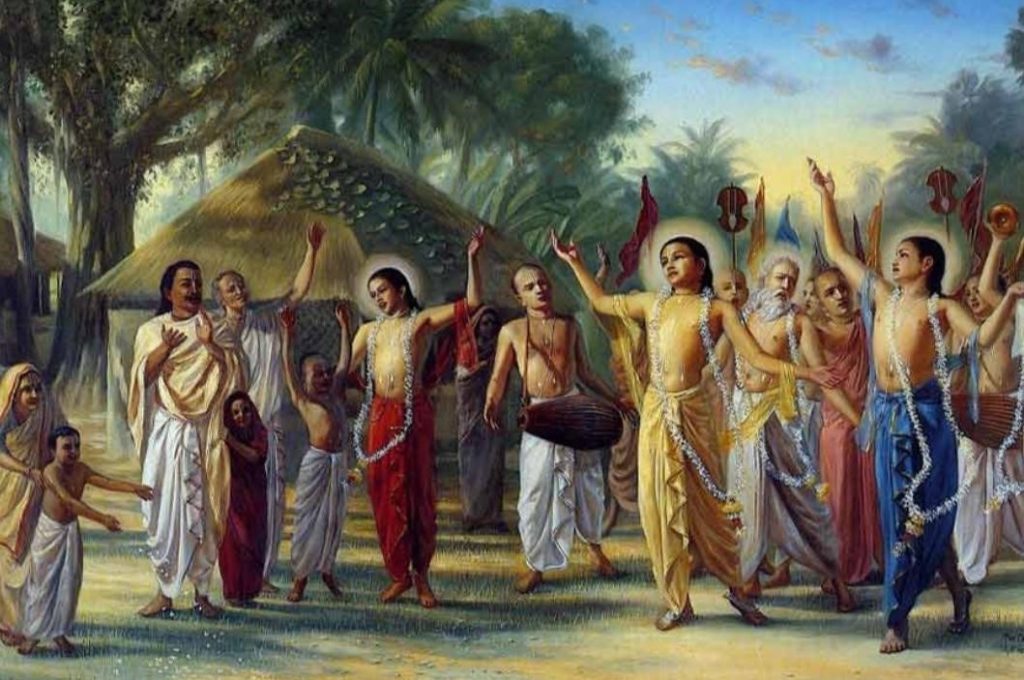
Reflections and pointers for applying the Gita’s teamwork teaching
Shared purpose: A team must have a higher goal than individual ambition. When the purpose is aligned with dharma and service, motivation rises.
Mutual respect and nourishment: Just as verse 3.11 speaks of “nourishing one another,” team members should care for each other, help each other, support one another’s strengths and give strength in weaknesses.
Surrender to higher principle: When teamwork is offered as service to Lord Krishna, activities become purified and take on transcendental value (yajñārtha-karma). Prabhupāda emphasises that yajñas lead to purification and ultimately Krishna-consciousness.
Ego-dissolution: True teamwork means stepping beyond “I” to “we.” In the Gita’s context, it means offering work to the Lord and cooperating rather than competing.
Resilience in failure: A team centre-ed on service transcends mere results. Even in failure, the journey becomes fruitful if the motive remains pure and cooperation continues.
Continual learning: Cooperation exposes us to new ideas, different personalities, diverse strengths. This multiplicative learning factor is one of the great benefits of team effort.
Spiritual dimension: In Gaudiya Vaishnava understanding, teamwork with Krishna at the centre is not merely efficient but sanctifying. The collective work becomes a vehicle of devotion (bhakti), transcendence of the three modes (guṇas), and ultimately unity with the Supreme.
In conclusion, teamwork, when rooted in the wisdom of the Gita, becomes far more than operational synergy—it becomes spiritual synergy. Cooperation under a higher ideal, with mutual support and service attitude, aligns team effort with cosmic order and divine purpose. When each member sees the other as a part of the same mission and offers that mission to the Supreme, the team becomes an instrument of universal welfare.
Hare Krishna!
Courses links
Follow the Learn Gita Live Gita channel on WhatsApp